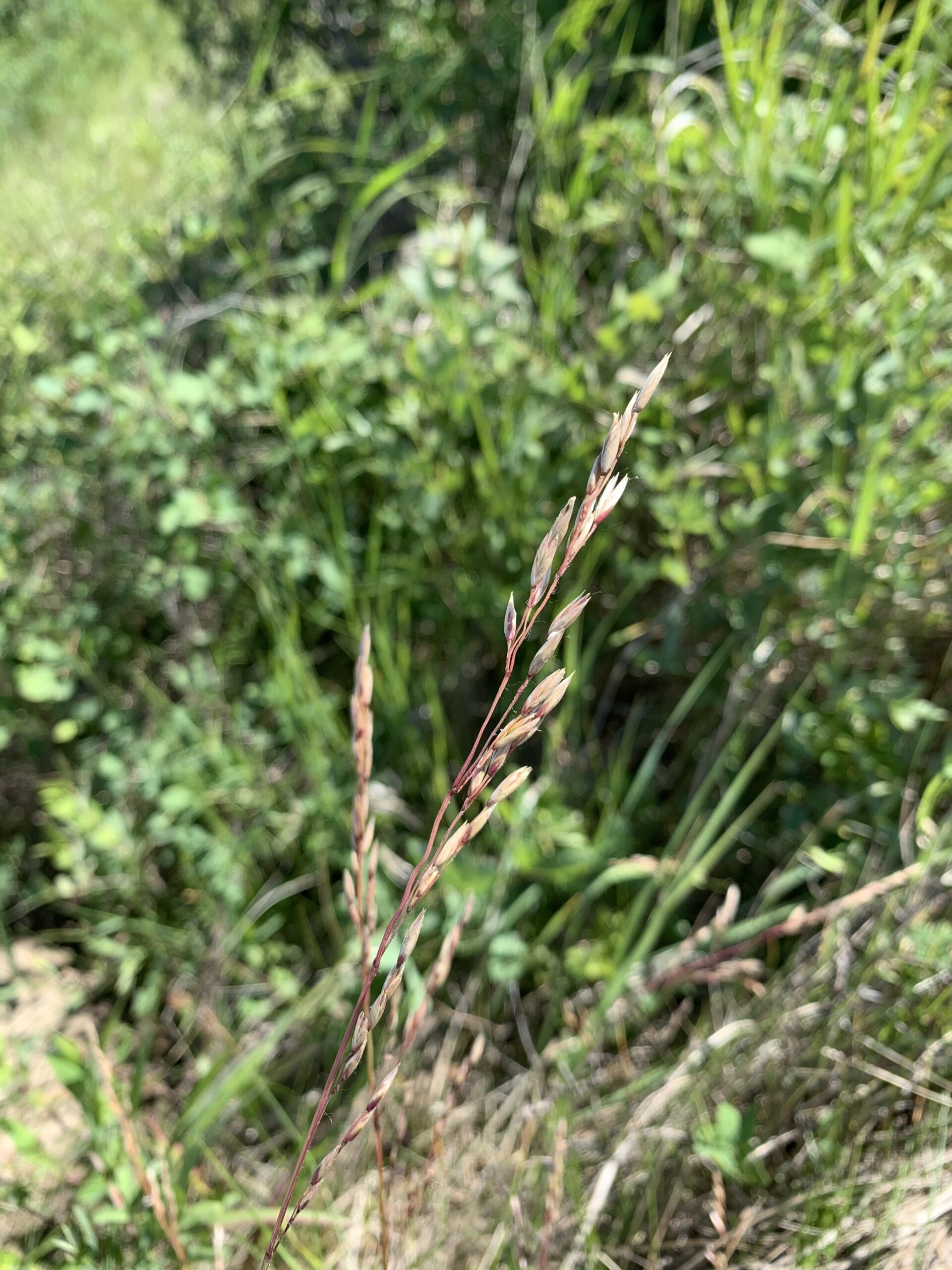
Rough fescue is a pretty generic name that encompasses a few main species. Most notable are Plains Rough Fescue (Festuca hallii) and Foothills Rough Fescue (Festuca campestris).
One memorable name I think many of you are familiar with is “Prairie Wool.” That’s rough fescue for you! So named because of the color and bunches left behind in the fall almost literally looks like wool on a sheep.
Rough fescue has to be one of my favourite native grass species. It’s not my only favourite, of course, but it’s pretty well at the top. And no, it’s not because it’s been named as Alberta’s provincial grass. Sorry, haha!
See, I never knew about this grass until I took a plant ID course in university. When the prof first introduced me (and the rest of my classmates) to rough fescue, I was taken aback and amazed at its attributes as a true native species of the Canadian Prairies.
Not only did it sustain the wild grazing herbivores for many, many years, long before the European settlers arrived, its particularity for being ideal for grazing in the winter as opposed to summer is something I found fascinating.
We’re all too familiar with grazing always being in the summertime, at least I was growing up on the farm. My own version of reality was that grazing was only during the summer, and forages had to be collected to feed animals during the winter. Tame perennials are “softer” plants that generally, for the most part, don’t hold much up to snuff over the winter. (Where I grew up, we had nothing but naturalized “soft” perennials at our disposal: not much for native grasses to do much with.)
This is a much different story for “hard” plants/grasses like rough fescue, built tough to withstand fall and winter grazing. I’ll get to that in a minute.
The weakest point of rough fescue is during the summer. Range scientists call it a “decreaser” species because if animals are favouring it too much during the growing season in the stand, it decreases in population in the rest of the community. It’s both a good and a bad trait to have.
Good, in that it isn’t given a chance to dominate the stand when it’s grazed at the right time and for the right reasons. Rough fescue has a tendency to, when not grazed for a significant period of time (a time span of years, let’s say), take over the stand and reduce any opportunity for other plant species to germinate and grow. Bad, in that animals really like it to where, if given a chance, they’ll continue to favor it over other species.
Note that this is a conventional continuous grazing, not grazing that is of the likes of short-duration-long-rest grazing which goes by many names. Under such conditions, animals, especially livestock, are free to overgraze to their hearts’ desire. Therefore, rough fescue’s inability to withstand continuous grazing context would be seen as a “bad” thing.
Despite it being a bunch grass, meaning it grows from a designated bunch and not from rhizomes that spread out from the parent plant every which way, it still produces enough leaf matter and leaves behind enough (dead) leaf matter when it goes into dormancy to block out other seeds and seedlings from reaching sunlight and water. This, again, is if it has not been grazed for quite some time. Too much of this thatch layer isn’t good for the rough fescue plant either.
We must remember that grasses aren’t like deciduous trees, which can shed their leaves after going dormant; grasses’ leaves don’t shed off; they remain on the stem until some mechanical or biological disturbance destroys that attachment and begins breaking down the material into smaller and smaller pieces. If no such disturbance occurs, the old material remains even when new leaves arrive, and also die. Too much of this prevents much moisture from getting down to the roots causing moisture stress (or, alternatively, doesn’t allow sufficient moisture to leave, resulting in root/crown rot), and sunlight to also punch through. Daughter plants in the bunch (called “tillers”) gradually die off until not much of the bunchgrass is left.
This is why grazing is important. Grazing removes that excess dead plant material to allow moisture to move more freely in and out from the base of the plant as well as the soil, and sunlight to get through to encourage new seeds to germinate and grow.
Deferred grazing is the terminology used to discuss fall or winter grazing of particular pastures or grasslands that aren’t hit with significant herbivory until fall or winter. This is the kind of system that range folks talk about being best or more favorable for rough fescue, as mentioned above. It’s putting animals on at a time when the plants have finished growing and have already set seed (if the year allowed it), and aren’t going to be impacted with animals eating green leaf material.
Does this mean that rough fescue should only be grazed in the winter? Of course not. It can be grazed at any other time of year, just so long as grazing management allows it to thrive as part of the larger grassland/savanna ecosystem. That may mean grazing lightly with long rest periods. If utilization is heavy (no matter if it’s on purpose or accidental), then giving longer-than-normal recovery periods will be necessary to make sure it’s not being pushed out entirely.
Think of the old bison herds. Maximum animal impact with very long recovery periods where those animals likely didn’t return until at least a year or two later, if not longer. This is a clue to what grazing management should look like.
Some old naturalist and indigenous records and stories say the Canadian prairies were wintering grounds for the southern (American) bison herds, but that’s hearsay. However, I wouldn’t be surprised if that’s true.
Besides that, I found two other attributes pretty cool about F. campestris/hallii.
My range prof told us a story about a study that was done near Granum, Alberta, that saw a massive and pretty wicked grass fire in 1999 that destroyed several thousand acres of pristine Alberta foothills grassland. Besides the ecological progression from practically scorched earth to an impressive array of native legumes back to grassland again, grad students were set to study the number of tillers on a rough fescue plant.
Can you guess how many were found on one particular plant?
Over 200 daughter tillers. That’s right: TWO HUNDRED. I couldn’t believe it!
In this old Granum study, the plants that were studied in that burned area found that much of the rough fescue was burned so severely that they left these pocket indentations in the earth. Each of these remnants had been so badly burned that maybe two or three poor little tillers were left, still alive from that wicked, hot, slow-burning grass fire. Poor things!
Think about that: Two hundred down to only two or three survivors. Wow. Both are fascinating and heartbreaking at the same time.
But, those tough little survivors were the ones that the entire ecology relied on to help move the community from all but destroyed back to a healthy grassland again. It took around 5 or so years, but they were a sign of hope despite losing 99% of the plant… not to mention 99% of the entire plant community.
No doubt, too, many seeds were latent in the seed bank, waiting for the perfect opportunity to grow and regenerate the scorched landscape. Seeds (and tillers) of hope. Isn’t that something?
My final fascination with rough fescue is its pickiness when it chooses to flower and set seed. I can’t remember exactly how it goes, but the conditions have to be just right for these plants to shoot up their inflorescences (“flowers” in grass botanist lingo); they have to experience the right amount of stress to justify sexual reproduction as to their “usual” (dare I say it??) asexual reproduction through tiller production.
And when they do shoot up their inflorescences, it’s often in a beautiful, yet not-easy-to-spot tall cast of reddish, delicate and small spikelets gently waving in the wind. Like all grasses, they are often ignored or missed entirely in favour of the more brightly-pigmented wildflowers, but they’re there. They’re there.
Now for the more tedious details of rough fescue.
It has a high degree of forage quality in summer and winter. It keeps its quality in the winter, making it an ideal species for winter grazing.
It’s a deep-rooted grass species which forms beneficial relationships with mycorrhizal fungi.
Festuca campestris (Foothills Rough Fescue) is dominant in the foothills, stretching from Alberta south into Montana, Idaho and other Western states.
The species Festuca hallii (Plains Rough Fescue) dominates the wetter portion of the prairies that transition from true prairie dominated by Spear Grass (Hesperostipa comata) and Western Wheatgrass (Pascopyrum smithii). This wetter portion is considered a transition zone between the larger transition zone of Aspen Parkland and Mixed Prairie Grassland. It runs from Alberta east to Saskatchewan and Manitoba. A number of populations are also found in the States, like Wyoming, Montana, and North Dakota.
Any other interesting tidbits to share about rough fescue? Let me know!
0 Comments